
Biomass Power Generation

Unaffected by weather conditions, biomass power generation systems stably supply electricity 24 hours a day, 365 days a year.
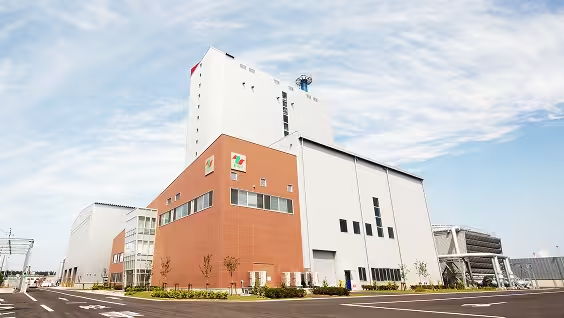
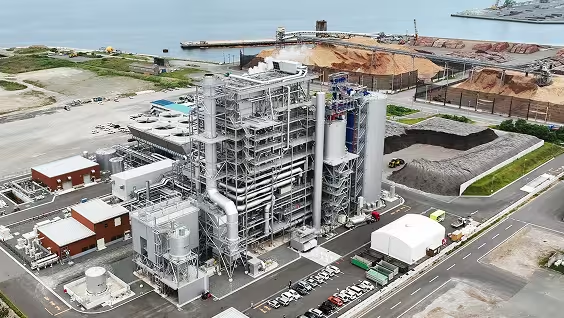
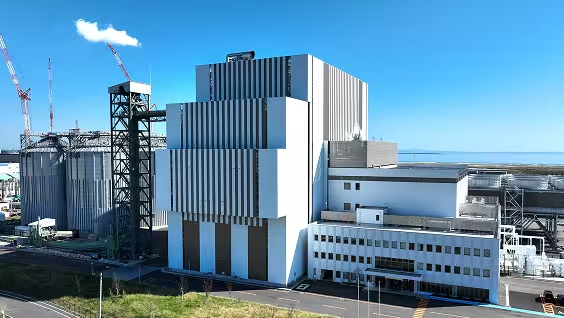
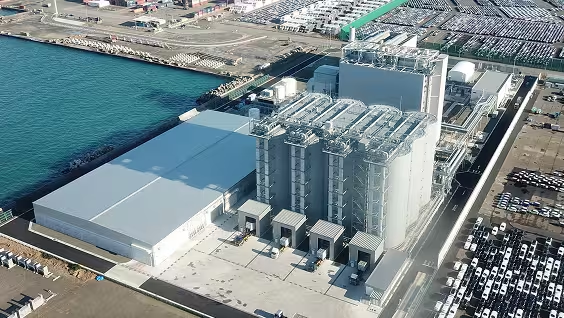
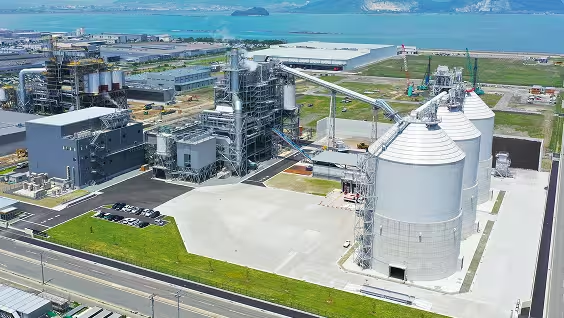
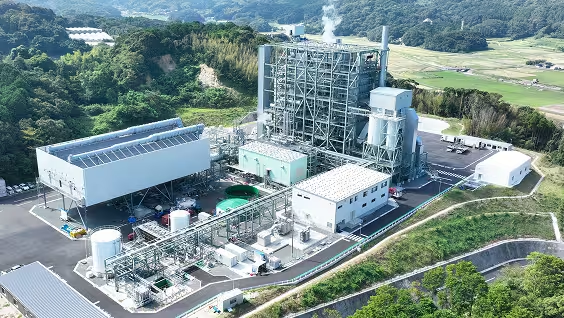
RENOVA operates biomass power plants at seven locations in Japan.

Power plants with a total capacity of 44 5MW are in operation.

RENOVA has built a network of seven wood-burning biomass power plants across Japan,
making it one of the largest biomass power generation companies in the country.

    Stable operation
    24 hours a day,
    365 days a year
    As a base-load power source that not affected by weather conditions, it increases Japan’s energy self-sufficiency.
    Operational structure
    including
    7 locations in Japan
    Through our network of seven locations nationwide, we ensure stable business operations. By sharing our expertise, we focus on disaster prevention and preventive maintenance while also contributing to the revitalization of local economies.
    Equivalent to
    electricity consumed by 970,000 households*
    Projected annual power generation is approximately 3,090,000 MWh
    We contribute to the decarbonization of Japan by stably supplying power.
    * Calculated based on the average electricity consumption of general households.

History of RENOVA’s Biomass Power Plants

RENOVA’s biomass power generation business began in Akita in 2016. Now, it is one of the largest in Japan. Our mission is to stably supply electricity 24 hours a day, 365 days a year. By thoroughly managing safety and operating stably, we protect the foundation of energy. Whild doing this, we contribute to the revitalization of local economies by creating employment opportunities and using ports. We work to create a sustainable future together with the local communities we are a member of.

Biomass Power Plant
Development Track Record

  • 2016
    Akita
    Akita Biomass
    20.5MW
  • 2021
    Fukuoka
    Kanda Biomass
    75.0MW
  • 2023
    Miyagi
    Sendai Gamo Biomass
    75.0MW
  • 2023
    Tokushima
    Tokushima Tsuda Biomass
    74.8MW
  • 2024
    Miyagi
    Ishinomaki Hibarino Biomass
    75.0MW
  • 2025
    Shizuoka
    Omaezakikou Biomass
    75.0MW
  • 2025
    Saga
    Karatsu Biomass
    49.9MW

Biomass Fuel

RENOVA’s biomass power plants use wood pellets, PKS, and wood chips. The features of these fuels are as follows:

Wood Pellets

Wood pellets are a type of wood fuel made by finely crushing and extruding materials such as thinnings and low-quality wood generated in forest management operations, as well as offcuts from sawmills.

Palm Kernel Shells (PKS)

Palm Kernel Shells (PKS) are a byproduct generated in the palm oil production process which uses the fruit of the oil palm.

Wood Chips

Wood chips are a type of wood fuel produced by cutting unused wood, such as thinnings, into small pieces using specialized machinery.

Our Approach to Biomass Fuels

Responsible Fuel Procurement

We procure fuels for our biomass power plant that comply with government guidelines, and we ensure the legality, sustainability, and traceability of these fuels using third-party certifications and other means.
We have also established our Sustainable Procurement Policy for Biomass Fuels, and we conduct surveys and interview major suppliers to confirm compliance with this policy.

Contributing to the Reduction of CO2 Emissions

The greenhouse gases emitted from the entire process of using biomass fuel, from the procurement of raw materials to their combustion at the power plant (including manufacturing and transportation), are referred to as life-cycle CO2 emissions.
The life-cycle CO2 emissions of our biomass power plants are more than 80% lower than those of conventional thermal power plants. This significantly contributes to the mitigation of global warming.

  • *1Life-cycle CO₂ emissions of thermal power generation plants assuming the projected energy mix in 2030 (Agency for Natural Resources and Energy, Business Planning Guidelines)
  • *2Average for our power plants
  • *3The generation of power using biomass resources, which absorb CO2 through photosynthesis during their growth process, is considered to be CO2 emissions-free under the Kyoto Protocol (Agency for Natural Resources and Energy, Nattoku! Renewable Energy).

Fundamentals of Biomass Power Generation Systems

Features of Biomass Power Generation Systems

The Stable Supply of Electricity 24 Hours a Day, 365 Days a Year

Unlike solar, wind and other sources of power that are affected by the weather, it is possible for biomass power generation systems to stably supply power 24 hours a day as long as fuel is available. They are a base-load power source that can supply electricity regardless of the weather.

Carbon-Neutral Energy

The plants used as fuel absorb CO2 through photosynthesis during their growth process. Because the CO2 emitted during combustion was originally present in the atmosphere, burning them is considered carbon neutral, meaning that it does not increase the overall amount of CO2 in the atmosphere.

Effective Utilization of Unused Resources

Unused wood from forests and agricultural byproducts are utilized as fuel. By converting resources that were previously discarded into energy, biomass power generation systems significantly contribute to the realization of a circular economy.

How Biomass Power is Generated

Biomass power generation systems burn biomass fuels to generate heat, which is used to generate steam which rotates a turbine to generate electricity.

1.Fuel is input into the system

Biomass fuels are stored in tanks or yards and supplied to the boiler.

2.Combustion in the Boiler

Fuel is burned in the boiler to generate high-temperature high-pressure steam, which generates power.

3.Turbine Rotation

The force of the generated steam is used to rotate turbines at high speeds to convert the steam energy into electricity.

4.Cooling and Circulation of Steam

After use, the steam is cooled. It becomes water again, which is then reused in the boiler.

5.Power Supply

The electricity generated is delivered to customers via the power grid.