
Globally, wind power is one of the major renewable sources of energy. In Japan, the installation of wind power systems has been accelerating since the feed-in tariff (FIT) system began in 2012. Although wind power is affected by weather conditions, the systems are able to operate day and night, and it is expected that they will be an extremely efficient method of generating electricity.

Wind Power Generation
Making wind a source of local pride, RENOVA works with communities to use wind to establish a better future.
Aiming to build  (including those in operation and under construction)
the onshore wind power generation business by 2030
In its “Medium-term Management Plan 2030,” RENOVA positions the the onshore wind power generation business as one of its core businesses.
We are promoting development projects across Japan, aiming to break ground on 400 MW of new capacity by 2030, while leveraging the insights gained from the Reihoku Amakusa onshore wind projects.
Current Status and Features of Wind Power Generation Systems
RENOVA’s Wind Power Generation Business
Harnessing the power of wind locally through a wind power
generation business that works together with the community to
create value.
As a company that uses nature, a precious local resource, RENOVA’s highest priority is coexisting and prospering together with local communities. In our wind power generation business, we have always continuously engaged in a dialogue with local residents from the very early stages of projects. We conduct rigorous environmental assessments and other surveys and are fully committed to addressing and resolving any concerns by proactively sharing information during public briefings that we hold voluntarily and implementing thorough safety measures. By having a deep understanding of the wind in the project area and working together with the community, we will create new value leveraging renewable energy.

Fundamentals of Wind Power Generation Systems
Wind Farm Development Process
It takes a long time to develop a wind power generation business, approximately 10 years from conception to the start of operations. This process is divided into two stages: the development and preparation phase, which involves site selection and the obtaining of permits and approvals, and the construction and operation commencement phase, which covers the period from the start of construction to the start of operations.
-
Preparation and planning (approx. 1–2 years)
This is the stage for laying the foundation of a wind power generation business. We select candidate sites and conduct detailed wind resource and environmental impact assessments. In parallel, we work to build a consensus with local residents to ensure that the project is feasible and that we will be able to coexist with the local community.

-
Preparation for construction and permitting (approx. 3–5 years)
We consult with government authorities and electric power companies to obtain permits, other approvals and connections to the power grids. We refine basic designs and business plans to make them more robust, and complete detailed designs and final procedures together with all relevant organizations.
-
Construction (approx. 2–3 years)
Civil engineering work on-site, the transportation of wind turbine components, and the installation of giant wind turbines finally begins with safety as the top priority. After all of the equipment is installed, it is meticulously tested and adjusted, and trial operations are conducted as the final preparation before stable operation.

-
O&M/ Operation and maintenance (O&M)
When commercial operations have begun, the project has fully launched with the goal of ensuring a stable supply of power over the long term. In addition to managing daily operations, we continuously and professionally maintain the power generation systems to maximize performance and ensure safety.
Dialogue with the Community
Note: The above is representative of the typical development process.
How Wind Power is Generated
The rotational energy of the wind turning the blades of the turbine is accelerated by a gearbox inside the turbine’s nacelle and transmitted to the generator. There, through a mechanism called electromagnetic induction, the rotational force is converted into electricity. Two points are extremely important in efficiently generating a large amount of electricity: selecting a location with strong winds and increasing the surface area that the wind strikes.

-
1. Blades
These are the wings that spin when they catch the wind. Their angle changes depending on the strength of the wind to enable them to rotate safely and efficiently.
-
2. Hub
This is the central part where the blades are connected. The rotational force is transmitted from the blades to the internal main shaft here.
-
3. Gearbox
This machine takes the rotation of the blades and increases it several hundredfold using gears. It converts the slow rotation into the high-speed rotation necessary to drive the generator.
-
4. Nacelle
This is the structure at the top of the tower that houses the generator and other components. In addition to protecting the generator and gearbox from wind and rain, it, together with the entire turbine unit, automatically changes orientation to match the direction of the wind.
-
5. Generator
This is the heart of the power generation system. It converts the high-speed rotational energy transmitted from the gearbox into electricity using the principle of electromagnetic induction.
-
6. Braking System
This device is used to safely stop the rotation of the blades and lock them in place during strong winds, such as during a typhoon, or during maintenance.
-
7. Tower
This is the pillar that supports the weight of the machinery. It is built to a sufficient height to capture the stable and strong winds at higher altitudes.
Wind Power Plants
-
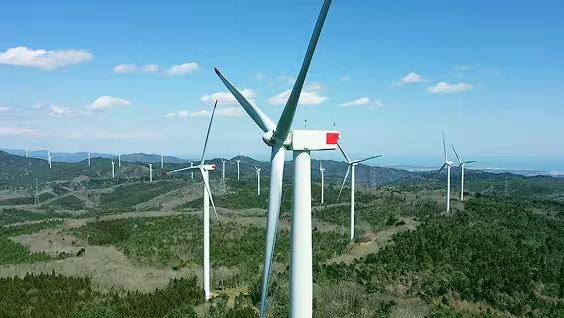 ©2025
©2025
Fukushima Fukko Furyoku, LLC.Abukuma Onshore WindFukushima Prefecture, Japan- April 2025
- Capacity:
- 147.0MW
In Operation -
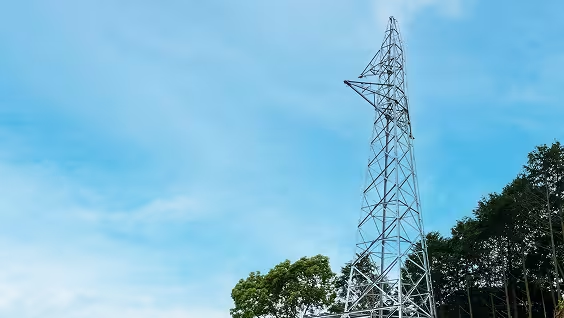 Reihoku Amakusa Onshore WindReihoku-machi, Amakusa-gun, Kumamoto Prefecture, Japan
- FY 2027 (plan)
- Capacity:
- 54.6MW
Under Construction -
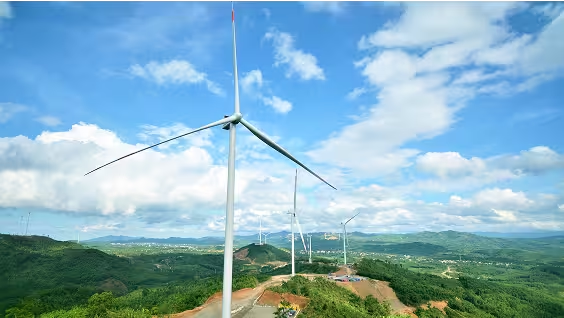 Quang Tri Onshore WindHuong Hoa District, Quang Tri Province, Vietnam
- October 2021
- Capacity:
- 144.0MW
In Operation