

Aiming to build a massive 0.9 GW energy storage network by 2030
In its “Medium-term Management Plan 2030,” RENOVA positions the energy storage business as one of its core businesses.
We are promoting multiple energy storage projects across Japan,
aiming for a total capacity of 0.9 GW (including those in operation and under construction) by 2030.
We are promoting multiple energy storage projects across Japan,
aiming for a total capacity of 0.9 GW (including those in operation and under construction) by 2030.
Track Record of Energy Storage Business Development
- 2023 August
- Start of Construction Himeji Energy Storage Facility (15 MW)
- 2024 April
-
Start of Construction Tomakomai Energy Storage Facility (90 MW)
Mori-machi Mutsumi Energy Storage Facility (75 MW)
Shiraoi Energy Storage Facility (50 MW)
Successful bids for three areas in the Long-Term Decarbonization Power Source Auction
- 2025 June
- Execution of Offtake Agreement for Ishikari Energy Storage Facility (30 MW)
- October
- Start of Operation at Himeji Energy Storage Facility (15 MW)
- December
- Start of Construction Yasugi Energy Storage Facility (2 MW)
- 2026 March
- Start of Construction Kikugawa Nishimura Energy Storage Facility
RENOVA’s Business Model in the Energy Storage Business
RENOVA’s energy storage business has a proven track record of development across three business schemes: “Market Trading,” “Off-take Agreements,” and “Long-term Decarbonized Power Source Auctions.” Currently, construction has commenced on facilities totaling 260 MW*.
*As of Q1 2025
*As of Q1 2025
1. “Market Trading” Buying and Selling Electricity in the Market
In this scheme, revenue is generated by selling power capacity and grid-balancing capabilities on various markets, such as the capacity market, wholesale electricity market, and supply demand adjustment market (ancillary service market).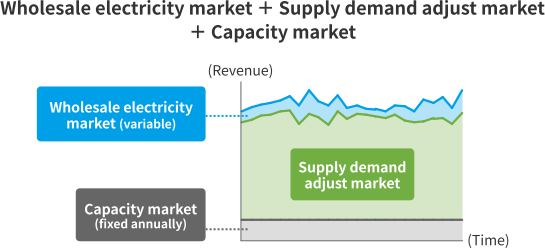
Capacity Market (OCCTO)
The Capacity Market is a mechanism where a price (capacity value) is paid in advance to power sources to ensure the necessary electricity supply capacity (capacity) for a specific future fiscal year (currently four years in the future). Suppliers, such as power generators, promise to secure and maintain a supply capacity in the future and receive income in return for this commitment.Wholesale Electricity Market (JEPX)
The Wholesale Electricity Market is a platform where power generators, retail electricity providers and others buy and sell electricity. Transactions are conducted, and prices are determined based on the daily supply of and demand for power.Supply-Demand Adjustment Market (EPRX)
The supply-demand adjustment market (also known as ancillary services market) is a platform for trading “adjustment capabilities”, - such as the ability to generate power, store energy or reduce demand, to maintain the balance between the supply of and demand or electricity in real time. Power generators, battery operators, and aggregators are paid to provide these adjustment services.2. “Offtake Agreement” Long-Term Contracts with Specific Customers
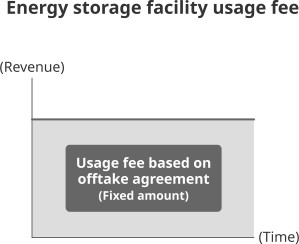
In this scheme, RENOVA grants customers the right to use battery energy storage systems (BESSs) and, in return, it receives a predetermined usage fee over a long period of time. As RENOVA handles the maintenance and management of the BESSs, the customer can use this system with confidence.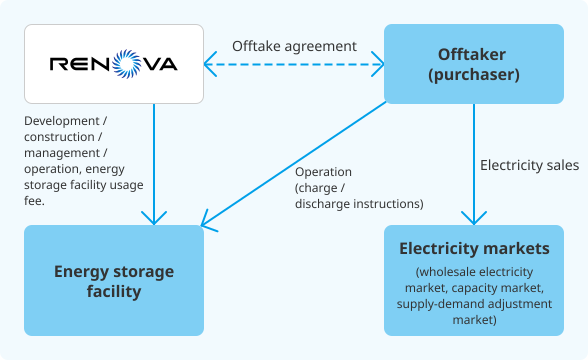
3. “Long-term Decarbonization Power Source Auction” Utilizing a National System
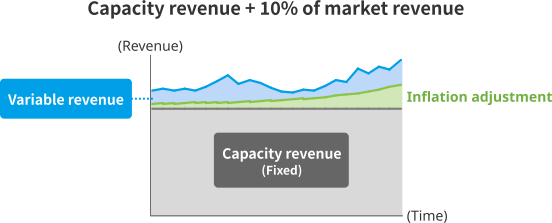
This is a method of securing stable revenue utilizing a national government program. In principle, you can receive a fixed amount of revenue from the government for 20 years that is determined by the capacity of the BESS.
Fundamentals of the Energy Storage Business
What is a Battery Energy Storage System (BESS) ?
Battery energy storage systems (BESSs), temporarily store electricity from power power generation system.
BESS is primarily composed of the following elements:
① Cell: The smallest unit for storing and using electricity.
② Module: Several cells bundled together.
③ Rack: A shelf inside a battery system on which the modules are installed.
④ Container: The enclosure that houses and covers all of these components.
① Cell: The smallest unit for storing and using electricity.
② Module: Several cells bundled together.
③ Rack: A shelf inside a battery system on which the modules are installed.
④ Container: The enclosure that houses and covers all of these components.
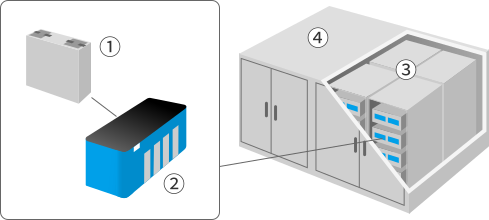
BESS, that connected to the power grid are called grid-scale batteries or grid scale energy storage systems.
There are two main types of grid-scale batteries.
There are two main types of grid-scale batteries.
| Grid-Scale BESS for Supply and Demand Response | These systems charge and discharge to adjust the balance between the supply and demand of electricity on the power grid. |
|---|---|
| Grid-Scale BESS Co-located with a Renewable Energy System | These systems temporarily store electricity generated from renewable sources of energy such as solar and wind power, and then release it when needed, time-shifting the use of the generated electricity. |
Strorage batteries are classified according to their performance and types of chemical substances and electrolytes they are composed of. Battery types include lithium-ion batteries (the most popular globally), manganese batteries, lead-acid batteries, lithium-sulfur batteries, aluminum-sulfur batteries, sodium-sulfur batteries, flow batteries, and all-solid-state batteries.
Principle Behind Lithium-ion Batteries
A BESS stores electrical energy by converting it into chemical energy during the charging of the BESS and then converts the chemical energy back into electrical energy when discharging the BESS.
Charging Process
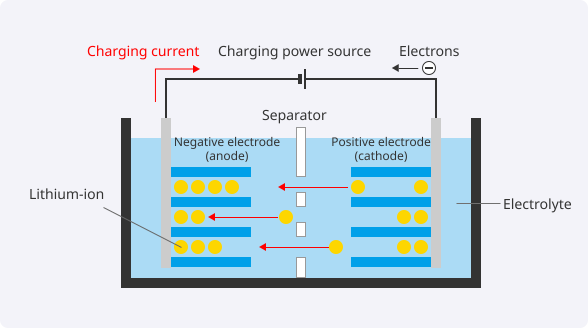
Charged particles (ions) move to one side of the cell (electrode) and accumulate there. At this point, the electrical energy is stored in the cell as chemical energy.
Discharging Process
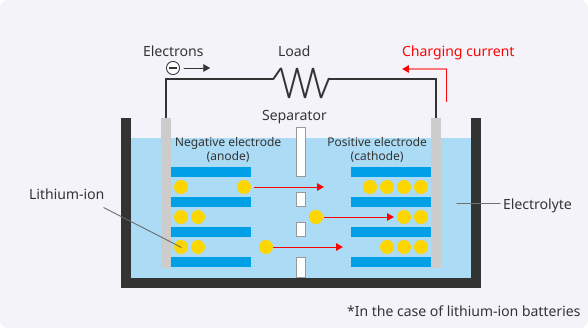
The ions stored inside the cell move toward the other electrode, generating an electric current. In this way, the stored chemical energy is converted back into electrical energy and sent out of the battery.
Benefits of the Widespread Adoption of BESSs
BESSs play a crucial role in power grid. With the spread of renewable energy, it contributes to the stable supply of electricity by adjusting the balance between electricity demand and supply and by releasing temporarily stored power when needed.

Improved Grid Stability
One of the great strengths of BESS is the ability to finely adjust the amount of electricity available using it. BESS can be used to regulate the input and output of electricity in response to changes in electricity consumption and the fluctuation of the generated solar and wind power. This contributes to the stabilization of the frequency and voltage of electricity and reduces the risk of power outages.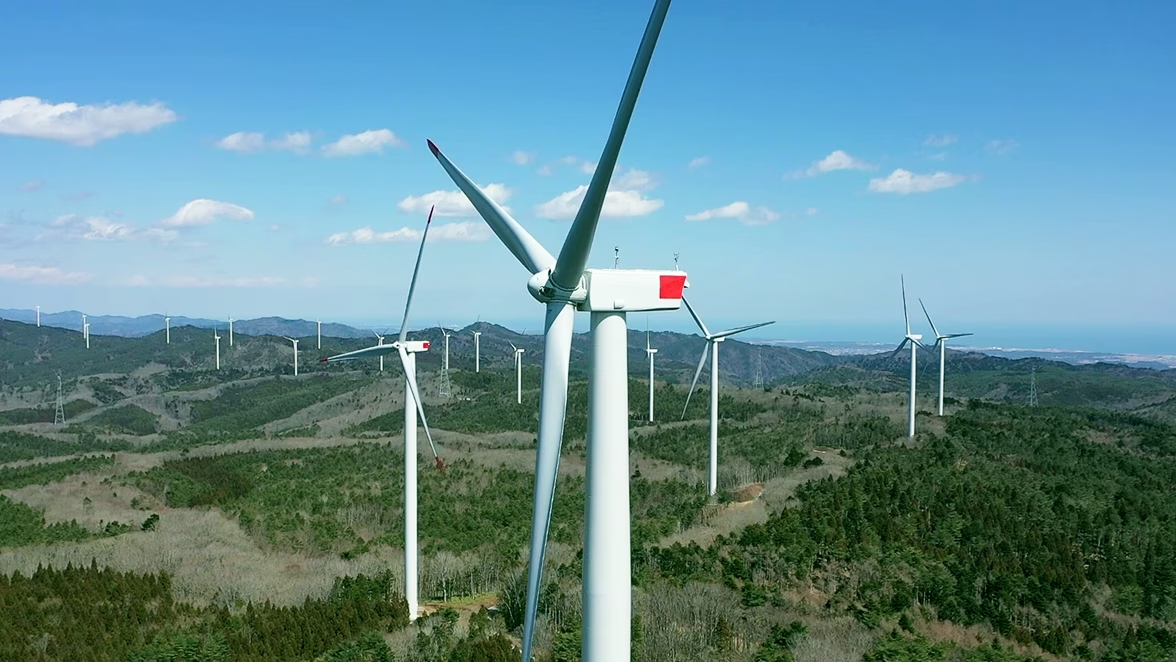
©2025 Fukushima Fukko Furyoku, LLC.
BESS: The Adjuster Making Renewable Energy the “Star”
A characteristic of renewable energy generation systems is that their output fluctuates depending on the weather and time of day. BESS complements these systems by compensating for the fluctuations, facilitating the stable supply of electricity.Energy Storage Facility
-
 Tomakomai Energy Storage FacilityTomakomai-shi, Hokkaido Prefecture, Japan
- FY 2028 (plan)
Under Construction -
Shiraoi Energy Storage FacilityShiraoi-cho, Shiraoi County, Hokkaido Prefecture, Japan
- FY 2028 (plan)
Under Construction -
Ishikari Energy Storage FacilityIshikari-shi, Hokkaido Prefecture, Japan
- FY 2027 (plan)
Under Construction -
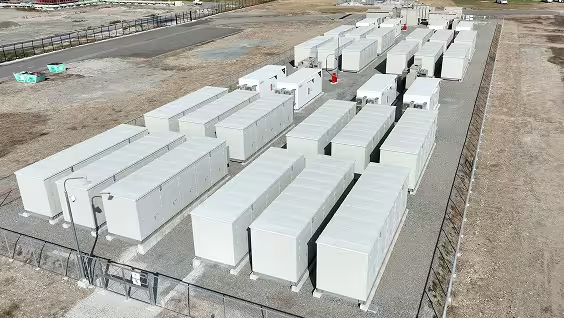 Himeji Energy Storage FacilityHimeji-shi,
Hyogo Prefecture, Japan- October 2025
In Operation -
Mori-machi Mutsumi Energy Storage FacilityMutsumi, Mori-machi, Shuchi County, Shizuoka Prefecture, Japan
- FY 2028 (plan)
Under Construction -
Yasugi Energy Storage FacilityYasugi City, Shimane Prefecture, Japan
- April 2026 (plan)
Under Construction -
Kikugawa Nishimura Energy Storage FacilityKikugawa City, Shizuoka Prefecture, Japan
- FY 2028 (planned)
Under Construction