
RENOVA’s Strength

From the development and operation of renewable energy and energy storage businesses to the securing of customers (offtakers),
RENOVA demonstrates its high-level expertise and know-how in all of the phases of projects.
RENOVA’s core strength is its comprehensive ability to seamlessly execute even the most highly challenging projects end to end.

Seamless Business Model

We seamlessly support all phases of projects, from power plant planning and development, optimal design and equipment procurement and complex financing, to high-quality construction, operation and maintenance. Furthermore, to maximize the utilization of generated power, we provide comprehensive services including the power supply to customers.

Development Capabilities Facilitating our Proposal of Value to and Coexistence with Local Communities

RENOVA has a dedicated team of approximately 70 experienced development professionals who have successfully handled over 25 business development projects. We reliably complete legal procedures such as permit and environmental assessment procedures, and we carefully build consensus with landowners. By sincerely addressing the complex and highly specialized processes of project development, we guide challenging projects to success using concrete solutions.
We value dialogue with local communities more than anything. We do not proceed with a development project without obtaining the understanding and consent of the people in the region. Our mission is to create customized value that local communities can proudly look toward in the future and be glad that this project began.

Ishinomaki Hibarino Biomass Power Plant

The Ishinomaki Hibarino Power Plant was constructed on the former site of a debris processing facility following the Great East Japan Earthquake in 2011. During the development and design phase, concerns were raised by local fisheries associations regarding the discharge of turbine exhaust cooling water into the ocean. In response, RENOVA independently conducted a fisheries impact study. Furthermore, by adopting air-cooled condensers, which is a technology rarely used in Japan, RENOVA was able to significantly reduce the amount of waste heat and wastewater discharged into the ocean, resulting in an environmentally friendly power plant.
› Read more

Karumai West Solar Power Plant

RENOVA and the town of Karumai shared the common goal of revitalizing mountain and farming villages and stabilizing energy supply and demand. They were among the first in the nation to take advantage of the Act on Promoting Generation of Electricity from Renewable Energy Sources Harmonized with Sound Development of Agriculture, Forestry and Fisheries, whose goal was to achieve both the introduction of renewable energy and regional revitalization. During the development project, the company engaged in a dialogue with the town and local forest owners’ cooperatives to establish a regional consensus. RENOVA overcame the complex adjustments required to obtain development permits, striving to create a safe and environmentally conscious power plant. A portion of the power generation revenue is returned to the community through the Blessings of Nature Fund, and this money is used for the preservation of the forest environment and the development of future community leaders. This has resulted in the establishment of a sustainable model for co-existence with the region.

Act on Promoting Generation of Electricity from Renewable Energy Sources Harmonized with Sound Development of Agriculture, Forestry and Fisheries: A law whose goal is to reconcile the renewable energy business and regional revitalization (the development of agriculture, forestry, and fisheries) by encouraging regional consensus-building and revenue sharing in agricultural, mountain, and fishing villages.

Ministry of Agriculture, Forestry and Fisheries: Act on Promoting Generation of Electricity from Renewable Energy Sources Harmonized with Sound Development of Agriculture, Forestry and Fisheries
https://www.maff.go.jp/j/shokusan/renewable/energy/houritu.html

› Read more

Engineering Supporting the Realization of Projects

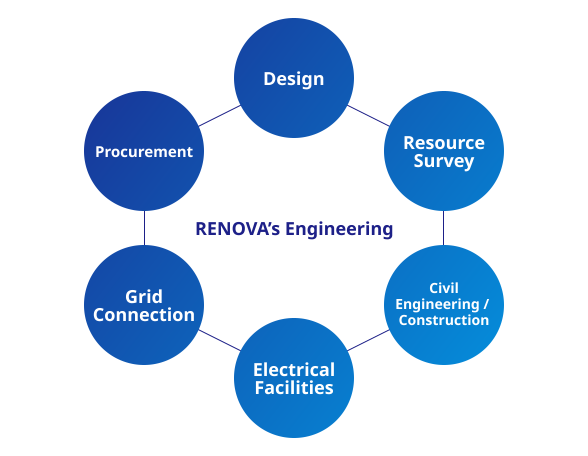
RENOVA has approximately 50 engineers who are deeply familiar with multiple sources of power: photovoltaic solar, BESS, wind, and biomass. One of our strengths is our integrated, in-house team of experts which are essential for power generation and energy storage development projects. They working closely with the development team. This team includes specialists in all fields: basic design, detailed resource surveys, advanced civil engineering technology, specialized electrical and grid facility planning, strategic procurement and wind resource observation.
By deeply engaging in projects from the early stages of development, this team enables us to lower generation costs, maximize generation efficiency, and procure optimal equipment at the best prices. As a result, we tenaciously seek and realize optimal solutions, succeeding in projects that others consider technically difficult.
Tomakomai Energy Storage Facility (illustration)

Development of Large-Scale Energy Storage Facilities

In 2023, RENOVA began developing large-scale energy storage facilities, with the goal of quickly commercializing them and expanding globally.. Believing that cost reduction is key to increasing the competitiveness of our business, our engineers mobilized their collective expertise to thoroughly compare and evaluate domestic and international suppliers. As a result, we realized both the early implementation of new technologies and high reliability in a short period of time, pioneering the optimal balance between cost and reliability in the industry. This effort, which includes our receiving three projects through the FY2023 Long-Term Decarbonization Power Source Auction (LTDA) and Battery Tolling (PPA) initiatives, is the driving force behind our achieving the introduction of 900 MW (approx. 2.8 GWh) of energy storage facilities by 2030.
› Read more
Construction of wind turbine foundations

Reihoku Amakusa Onshore Wind Power Plant

During the design phase, we faced profitability challenges because our civil engineering budget for the foundation of the wind turbines was significantly exceeded. While we consulted EPC (Engineering, Procurement, and Construction) contractors, a fundamental review was urgently needed. Our in-house engineers pursued the optimal balance between power generation volume and cost, considering factors such as changing wind turbine specifications. Through a rapid process of proposing hypotheses and verifying them, we identified an optimal solution that achieved both the generation of a large amount of electricity and a substantial reduction in the cost of civil engineering, which enables us to overcome this difficult situation using our advanced internal technical capabilities.
› Read more

A Leader in High-Leverage Financing

We have an in-house financing team with high-level expertise and a wealth of experience. This internal team, which understands the perspective of financial institutions, proposes solutions tailored to each project’s characteristics and risks. Through these efforts, they lead the financing process. Smooth negotiations with financial institutions enable the optimal and swift arrangement of project financing with minimized equity investment. This ability to resolve financing issues without relying on external advisors is the driving force behind our successfully securing financing, even for projects that are unprecedented in the industry.

Project Financing: A method of raising capital based on the profitability of a specific project. Because repayment is not sought from the parent company (non-recourse) and the loan is repaid only from the project’s revenue, the certainty of long-term, stable and solid revenue is strictly scrutinized.

Himeji Energy Storage Facility
(15GW, cost not disclosed)

The first project in Japan for which project financing was used was a project of ours in a “full merchant” energy storage business, where revenue is linked to market prices rather than being fixed as it is under the feed-in tariff (FIT) scheme. At the time, the energy storage business in Japan was in its nascent stage, and financing methods had not been established. Our team actively solved this challenge by proposing a unique financing mechanism tailored to the characteristics of the business to our partner financial institutions as a leader in financing arrangements. This track record demonstrates RENOVA’s strong financing capabilities and skills in the creation of solution-oriented proposals.
› Read more

Quang Tri Onshore Wind Power Plant
(144MW, approx. JPY 20 billion)

Leveraging our track record in the arrangement of project financing for multiple projects in Japan, we secured project financing for the first project in Vietnam’s onshore wind sector from the Asian Development Bank (ADB) and the Japan International Cooperation Agency (JICA). The high difficulty of the Power Purchase Agreement (PPA), which included Vietnamese country risks, was compounded by the risk that revenue would be significantly reduced if commercial operation was not achieved by a set deadline. Amid the travel restrictions and the disruption of materials procurement and logistics due to the COVID-19 pandemic, RENOVA was a leader in the financing of this project. We facilitated discussions with financial institutions by working closely with local partners and swiftly presenting solutions to challenges.
› Read more

Kanda Biomass Power Plant
(75MW, approx. JPY 40 billion)

RENOVA successfully arranged project financing for this large-scale biomass power project, which was rare at the time. We applied our proprietary knowledge and negotiation skills to tackle the most challenging task, the long-term procurement of fuel. In addition to risk analyses deeply examining fuel suppliers’ production systems, quality, and creditworthiness, we provided detailed information to financial institutions, including going with them to suppliers’ factory sites. By proactively proposing solutions to the concerns the financial institutions had, we succeeded in financing this difficult project.
› Read more

Operation to Maximize Stability and Profit

RENOVA operates facilities in highly efficient and stable ways by collecting and sharing operational knowledge from power plants both domestically and internationally. We have internalized the most critical operational functions: engineering, fuel procurement, power plant monitoring and maintenance. This enables us to repower (renovate) facilities in preparation for the post-FIT period, contributing to the long-term stable operation of our power plants for longer than 20 years and the improvement of profit. This deep commitment to our projects enables us to gain the trust of power purchasers (offtakers) and leads to the acquisition of new business opportunities. Our Power Plants and Facilities
Safety Assembly (Kanda Biomass Power Plant)

Formulation of the Sustainable HSE* Execution Policy

We have established our Sustainable HSE Execution Policy as the foundation that supports our stable operation of power plants, and strengthening our occupational health and safety management system is a top priority that we are committed to. This policy is thoroughly communicated to all stakeholders involved in the development, construction, operation and maintenance of sites. Through these continuous efforts, we promote the cultivation and entrenchment of a corporate culture that puts safety first.

*Health, safety, and the environment

› Read more

Sendai Gamo Biomass Power Plant

Since commencing commercial operation in November 2023, we have rigorously managed safety at the plant, achieving 500 consecutive days of accident-free and disaster-free operation as of April 2025. This success is built upon the knowledge gained through our operation of Akita Biomass (2016) and Kanda Biomass (2021). Our standardization and sharing of know-how in the areas of preventive maintenance, fire countermeasures, and fuel procurement at all of our power plants has contributed to this result. Furthermore, our biomass power plants in Kanda, Sendai, and Ishinomaki maintain high average utilization rates over 90%. We will continue to achieve stable operation based on the robust foundation of our business.
› Read more

Power Supply to Customers

RENOVA has specialists who are thoroughly familiar with renewable energy regulations and market environments and can accurately convey the value of our energy to customers. Leveraging this expertise and our ability to propose solutions, we accurately meet the needs of customers, and we have secured numerous Corporate PPAs (with a maximum contracted capacity of approximately 207 MW as of the end of September 2025). Furthermore, our high-quality multi-power source power plants and energy storage projects, which are handled by our in-house engineers, enable us to flexibly propose solutions tailored to the diverse needs of our customers.

Small-Scale Solar Power Plants (Non-FIT Solar PV)

RENOVA’s development know-how, cultivated through 13 mega-solar projects, is also being applied in small solar PV (Non-FIT) projects. The power generated by our robust power plants, built to a quality standard that enables them to be used for 30 years, is highly valued by customers because of the reliable quality and safety of our power plants, which is conducive to the establishment of long-term contracts and power purchase agreements (PPAs) with multiple companies.
› Read more

Biomass Power Generation Business

With a total capacity of 445 MW across seven locations across Japan, RENOVA is one of the country’s largest biomass power producers. Biomass is a stable source of power, as biomass power plants can operate 24 hours a day, and we ensure stable supply with a high utilization rate that is over 90%. In the operation of our business, we value coexisting with local communities. Regarding fuel procurement, we have established our Sustainable Biomass Fuel Procurement Policy in addition to national guidelines. Our commitment to stability and sustainability is highly valued, and we continue to sign new PPAs for the electricity we generate at biomass power plants.
› Read more